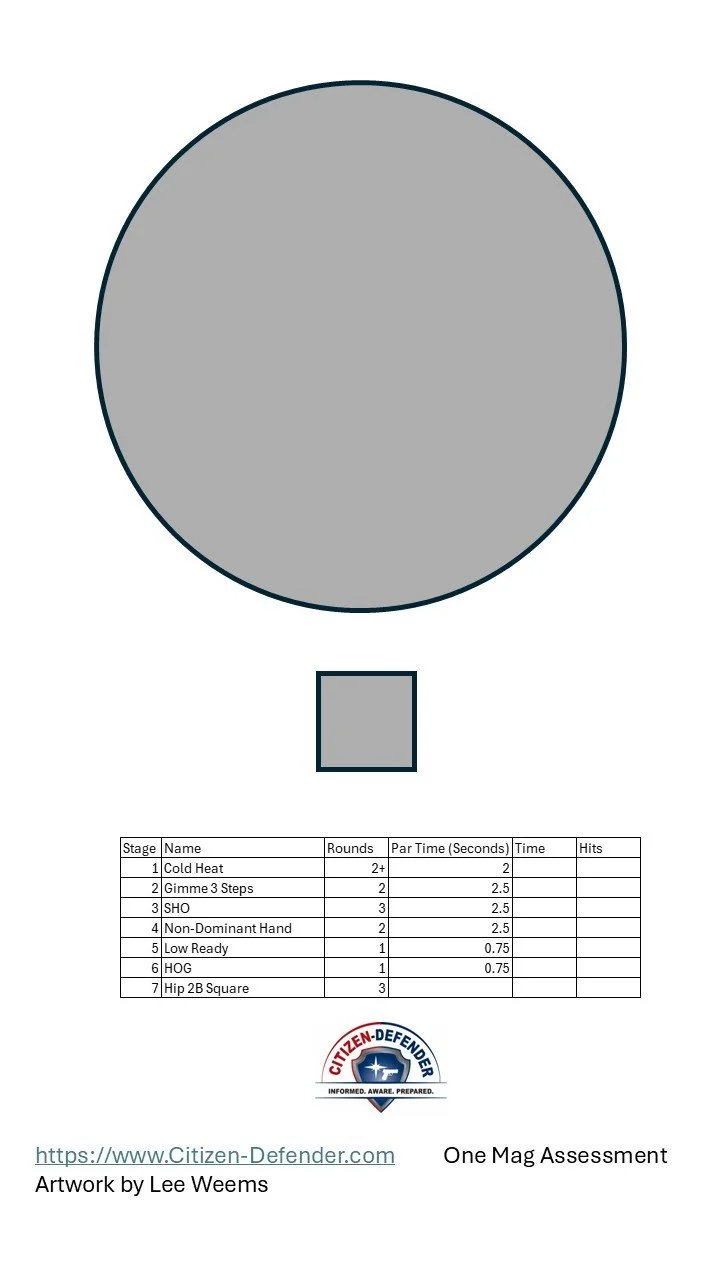
The One Mag Assessment
The One Mag Assessment (OMA)
Obtaining a true measurement of our defensive pistol skills requires an ego divested assessment of our cold and on “command” skills. (As opposed to the “on demand” performance required in a lethal defensive encounter.) This is best achieved with a programmed course of fire that focuses on the most likely defensive use of our pistol.
There are a variety of low round count drills that provide this measurement. Tom Givens of Rangemaster has the “Baseline Assessment”, and we get the “Five Yard Round Up” from Justin Dyal. My offering in this regard is the OMA, or “One Mag Assessment” which borrows heavily from other instructors with a few of my own twists thrown in. OMA consists of seven stages of fire which are fired from five yards. Six have par times, the last is pure accuracy that is timed to provide measurement for the record. Three incorporate highly desired elements for a self-defense shooting, those being movement or verbalization.
Requirements:
-15 rounds of training ammunition
-Print the attached target or use the Langdon Tactical Target OR a B-8 and a 1” square target paster OR any target with a 5.5” bullseye and a 1” square target paster.
-Shot timer
Scoring: All rounds must hit the 5.5” circle or the 1” square to be counted as a hit.
Range: All stages are fired from five yards, or “one car length” in Citizen-Defender terms.
Courses of Fire
Stage One: “Cold Heat” (Hat tip to Simon Golob)
This stage tests your ability to rapidly deliver shots to a defined target that corresponds with the high center mass of a human chest…a prime consideration for defensive pistoleers.
Start with a holstered and concealed pistol. At the signal, obtain as many hits as possible in two seconds. Two hits are good, three excellent. Four and you’ve really validated your grip and draw stroke, as well as trigger and recoil control. Record hits/time. (It’s easy to go past the stop beep in this drill. There’s a lesson there, I think…)
Rounds Expended: 2-3 (4!)
Stage Two: “Give me Three Steps”, (courtesy Lynard Skynard)
This stage measures your ability to “depart the line of force” while delivering accurate shots. Being where the incoming bullets aren’t while delivering accurate fire is a skill that we don’t spend nearly enough time working on.
At the signal, fire two rounds while moving laterally left or right at least one body width.
Start with holstered and concealed gun. Par is 2.25 seconds. Record hits/time.
Stage Three: Strong Hand Only (Hat tip to Justin Dyal)
Start from a low ready position. (Defined as finger off the trigger, muzzle indexed at the base of the target.) At the signal, fire three rounds in less than 2.5 seconds. Record hits and time under 2.5 seconds.
Stage Four: Support Hand Only (Hat tip to Tom Givens)
Safely transfer the gun to your non-dominant hand and start from a low ready position. At the signal, fire two rounds in 2.5 seconds. Record hits and time.
Stage Five: Low ready
Many defensive encounters start with gun in hand and the aggressive subject verbally challenged. This defensive display puts the aggressor on the horns of a dilemma. Comply and depart the scene or get shot. Given the speed that a subject can close five yards it is important to know how quickly you can deliver a decisive hit in that time/distance window. (Check out this video for low ready rationale and nuances.)
Start with the gun at low ready and issue the verbal command of “STOP!” At the signal, fire one shot into the target. Par time is .75 seconds. Record hit and time.
WARNING: In many states drawing to the low ready may result in a “brandishing” charge and possibly an assault with a deadly weapon. Be prepared to articulate your reasonable fear if you employ the HOG.
Stage Six: Hand On Gun (HOG)
A defensive encounter may initiate at such proximity that drawing to a ready position may result in a tussle for the gun, or in circumstances where completely displaying the firearm may be inappropriate.
Start with a firing grip on the holstered pistol and issue the verbal command of “STOP!” On the signal, fire one shot. .75 seconds par time. Record hit/time under par.
WARNING: In many states performing the HOG may result in a “brandishing” or possibly an assault with a deadly weapon charge. Be prepared to articulate your reasonable fear if you employ the HOG.
Stage Seven: It’s Hip to be Square
Use the provided target or place a 1” paster somewhere on the target or backer away from other shot holes or use a square on a Langdon target. Start aimed at the black square, slack out of the trigger. On the signal, fire three shots as rapidly as possible while hitting the square three times. Success will really validate your grip, failure means you’ve got some work to do. If the sights consistently return to the target, you’ll finish faster as long as you’re moving the trigger appropriately and maintaining a good grip. Plus, you’ll really gain appreciation for your ability to pull off a precision shot. And the ability to hold a 1” group at 5 yards is a very good indicator of how well you’ll be able to hit at 25 yards and beyond. Record hits and time.
If at the end of the OMA if you’ve only fired 14 rounds, repeat stage 5 or 6. I think it is a good idea that you record performance under the par times to measure strengths and reapportion effort to areas where you’re lacking a bit.
To spice things up, have a partner run the OMA out of order. You have no idea what will be required until a second or two before the string begins and you’re told the course of fire. You can also get a good idea of your reaction and processing time by using a Determinator and a shot timer with a silent function.
How do you score this? Well, start by keeping the skills you’re working on in context. Visualize a living, breathing mortal threat with a mind of its own, and reflect upon that fact that you’ll likely be performing with minimal notice. Speed is fine, accuracy is final, to borrow a well-worn phrase. Concentrate on getting all hits, then start ramping down your times.
DO NOT become “pre-occupied with inconsequential increments” per Colonel Cooper. This is intended to be a yardstick, not a micrometer. And never lose sight of why you’re carrying that pistol.
Just Get Home!
John Murphy